
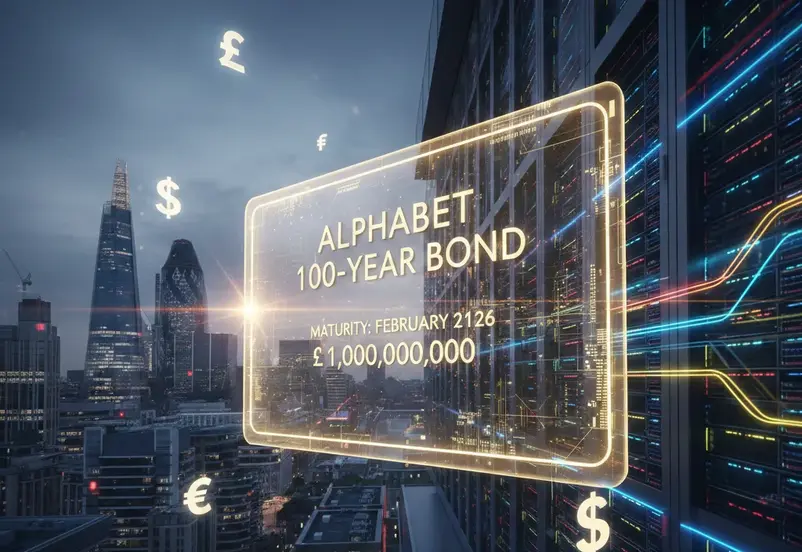
Alphabet, the parent company of Google, has raised $20 billion in one of the largest corporate bond sales in recent memory—and investor demand was so strong that the company bumped the offering up from the original $15 billion target. Most striking: Alphabet is issuing a 100-year bond in the UK market, an instrument so rare that the last major corporate example was Motorola in 1997. The massive debt raise comes just days after Alphabet and Amazon announced staggering AI capital spending plans that dwarf anything corporate America has attempted before.
The Numbers Behind the Raise
- Original target: $15 billion in USD-denominated bonds
- Final raise: $20 billion after overwhelming investor demand
- Multi-currency: Alphabet is also issuing its first instruments in British pounds and Swiss francs
- 100-year bond: Being offered in the UK market—a so-called “century bond” almost never seen from corporations
The resounding demand is a clear signal that investors are willing to back Big Tech’s AI ambitions with real capital, even as questions linger about whether these massive investments will ultimately pay off.
Why Now: The AI CapEx Arms Race
The bond sale follows a week of jaw-dropping capital spending announcements from the tech giants:
- Alphabet: Up to $185 billion in AI infrastructure spending planned for 2026
- Amazon: Up to $200 billion in capital expenditures announced the following day
These are the largest capital spending commitments any companies have ever made. The hyperscalers—Alphabet, Amazon, Microsoft, and Meta—are locked in an aggressive competition to lead the AI race. The logic driving the spending is familiar from previous tech platform battles: in markets like search, mobile operating systems, and web browsers, one company tends to win and capture the vast majority of profits. Nobody wants to be the one left behind.
While these companies have enormous cash reserves, they don’t want to deplete them entirely. Tapping debt markets at favorable rates allows them to fund the AI buildout while preserving balance sheet flexibility.
Build the 100-Year Future of Tech
From century bonds to $185B in AI capex, Alphabet is rewriting the rules of corporate scale. Whether you’re an engineer building Gemini-ready data centers or a strategist managing global liquidity, join the teams defining the next century of innovation in 2026.
Search Alphabet & Tech Roles →The 100-Year Bond: Confidence or Hubris?
Century bonds are extraordinarily rare in the corporate world. They are typically issued by governments or universities—the University of Oxford has issued them in the past—entities expected to endure for generations. For a corporation to issue a 100-year bond is a bold statement of confidence in its own longevity.
But history offers cautionary tales:
- Motorola (1997): Issued 100-year bonds when it was the undisputed leader in mobile phones. It subsequently lost ground to Nokia, then BlackBerry, then Apple—and was eventually sold, unable to maintain its independence
- J.C. Penney: The once-dominant retailer issued century bonds and then went bankrupt just 23 months later
No one expects Alphabet to face that kind of collapse in the near term. It remains one of the most profitable companies in the world, with dominant positions in search, digital advertising, cloud computing, and the Android ecosystem. But as the Motorola and J.C. Penney examples illustrate, 100 years is a very long time—and investors buying these bonds are making a bet that Alphabet will remain creditworthy for a century.
Can Big Tech Keep Getting Funded?
A key question heading into the bond sale was whether investors would actually provide the capital to fund these enormous AI bets. The answer, at least for now, is an emphatic yes. But skeptics point to several risks:
- Circular financing concerns: Some analysts worry about a cycle where tech companies invest in AI infrastructure, then sell AI services primarily to each other—raising questions about where the ultimate end-user demand comes from
- Returns timeline: These are long-term bets with uncertain payoff horizons. AI infrastructure built today may take years to generate returns commensurate with the investment
- Stock price pressure: Tech stocks have pulled back from October highs, partly due to investor unease about the aggressive spending plans
- Dot-com parallels: The level of exuberance around AI has drawn comparisons to the late 1990s tech bubble, though today’s companies are far more profitable than their dot-com era predecessors
The difference between 2026 and 1999, supporters argue, is that companies like Alphabet and Amazon are generating hundreds of billions in annual revenue and substantial free cash flow. They are not speculative startups burning cash on unproven business models. But the scale of the spending is unprecedented, and history has shown that even dominant companies can misjudge technology transitions.
Building the Next Century of Infrastructure?
The “AI Arms Race” is won with hardware and power. Whether you need infrastructure architects or specialized network engineers, reach 250M+ candidates and find the 1% of talent who can turn billions in funding into reality with WhatJobs.
Recruit Infrastructure Experts Now →What It Means for Investors
For bond investors, Alphabet’s offering provides exposure to one of the most financially strong companies in the world at a time of elevated interest rates. The century bond, in particular, offers a premium yield for those willing to accept the extreme duration risk.
For equity investors, the successful bond sale is a positive signal: it means Alphabet can fund its AI buildout without diluting shareholders or draining cash reserves. But it also means the company is taking on significant debt obligations that will need to be serviced for decades.
For the broader market, the overwhelming demand for Alphabet’s bonds confirms that institutional investors remain bullish on Big Tech’s AI strategy—even if the stock market has grown more cautious.
Frequently Asked Questions
Q: How much did Alphabet raise in its bond sale?
A: Alphabet raised $20 billion, up from an original target of $15 billion, after receiving overwhelming investor demand. The offering includes bonds in USD, British pounds, and Swiss francs.
Q: What is a 100-year bond?
A: A 100-year or “century” bond matures in 100 years. They are extremely rare for corporations—typically only issued by governments or universities. Alphabet’s 100-year bond is being issued in the UK market.
Q: How much is Alphabet planning to spend on AI?
A: Alphabet has said it could spend up to $185 billion in 2026 on AI infrastructure. Amazon announced up to $200 billion in capital expenditures. These are the largest corporate CapEx commitments in history.
Q: What happened to other companies that issued 100-year bonds?
A: Motorola issued century bonds in 1997 when it led the mobile phone industry—it later lost its market position and was sold. J.C. Penney issued century bonds and went bankrupt 23 months later. These examples illustrate the risk of betting on any company’s 100-year survival.


