
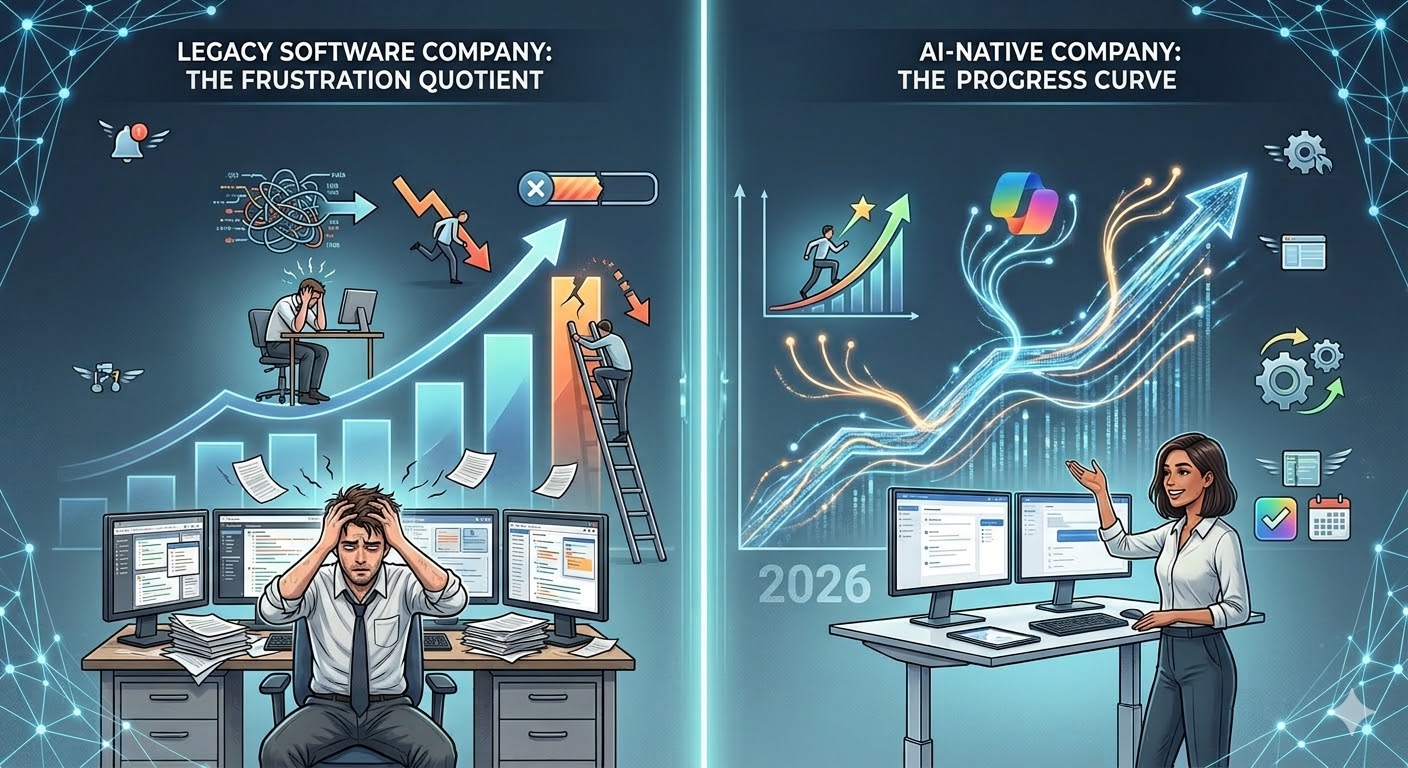
A Freshworks survey of nearly 9,000 workers worldwide found that 91% of employees are frustrated by inadequate workplace technology. Not mildly annoyed. Frustrated. And 71% of business leaders admitted their people would consider looking for a new employer if they couldn’t access the tools they needed to do their jobs well.
That stat alone should keep every HR manager up at night. But here’s what makes it worse: most companies don’t connect the dots between their creaking software systems and the resignation letters piling up on their desks. They blame culture, compensation, or management style. They rarely blame the 15-year-old ERP system that crashes every Thursday.
This article breaks down what the research actually says about legacy software, employee satisfaction, and retention. The numbers paint a clear picture, and it’s not a pretty one.
The Hidden Link Between Old Software and High Turnover
Let’s start with the obvious question. Why would software make someone quit?
Because bad tools don’t just slow people down. They make people feel like their time doesn’t matter.
Freshworks’ research found that 57% of employees who were unsatisfied with their workplace technology said it made them less productive. Think about what that means day-to-day. You’re an HR coordinator trying to process payroll through a system that takes 11 clicks to do what should take two. You’re a project manager copy-pasting data between three spreadsheets because your legacy platform doesn’t integrate with anything built after 2014. You’re a recruiter who loses candidates because your applicant tracking system looks like it was designed for Windows XP.
That daily friction compounds. A study published in the Behavioral Sciences journal in 2024 confirmed what most of us already sense: employee satisfaction with workplace technology directly affects morale and productivity. Ivanti’s 2024 Digital Employee Experience Report, surveying 7,800 professionals globally, reached the same conclusion: technology significantly influences not just productivity but also satisfaction and retention.
MIT Sloan Management Review published a finding that should stop every executive in their tracks: toxic corporate culture is ten times more important than compensation when predicting who will quit. And few things poison a work culture faster than tools that make simple tasks painful. When employees spend their days wrestling with clunky interfaces and workaround processes, resentment builds. It’s not the software itself people hate. It’s the message it sends: “We know this is broken, and we’re not going to fix it.”
The retention data backs this up. Culture Amp estimates that replacing a single employee costs between 30% and 200% of their annual salary. The Work Institute’s 2024 Retention Report found that U.S. companies spent close to $900 billion replacing employees who voluntarily quit in 2023 alone. Gallup’s research shows that 42% of those departures were preventable.
Connect the dots. If outdated technology drives frustration, frustration erodes engagement, and disengagement drives turnover, then every quarter you delay modernizing your systems, you’re writing checks to recruiters that should be going toward better tools.
What Legacy Systems Actually Cost You (Beyond the IT Budget)
Most executives see legacy system costs as an IT problem. Something the CTO worries about. That’s a mistake.
Yes, the direct financial burden is staggering. According to a U.S. Government Accountability Office (GAO) report, federal agencies typically spend about 80% of their annual IT budget on maintaining existing systems, including legacy infrastructure. Enterprises aren’t far behind. Multiple industry analyses, including data from Gartner, place legacy maintenance at 60% to 80% of total IT spending across private-sector organizations. Gartner further projected that by 2025, companies would be allocating 40% of their IT budgets specifically to managing technical debt.
But the real damage happens outside the IT department. Consider what legacy systems cost in human terms:
- Developer productivity collapses. Stripe’s Developer Coefficient report found that the average software developer spends 17.3 hours per week on maintenance tasks like debugging, refactoring, and dealing with bad code. That’s 42% of a 41.1-hour workweek spent fixing the past instead of building the future. Across a 25-person engineering team earning average salaries, that’s roughly $990,000 annually in lost productivity.
- Onboarding grinds to a halt. New hires take longer to become productive when they have to learn convoluted legacy workflows. Research shows that 29% of employees quit within their first 90 days, and a poor technology experience during onboarding accelerates that timeline.
- Cross-department friction increases. When your HR platform can’t talk to your finance system, when your CRM doesn’t sync with your project management tools, people fill the gaps manually. That’s not just wasted time; it’s a breeding ground for errors, miscommunication, and resentment between teams.
For organizations that recognize the problem and want to act, working with a specialized legacy app modernization services provider can help untangle decades of technical debt without disrupting daily operations. The goal isn’t to rip out everything overnight. It’s to build a phased roadmap that prioritizes the systems causing the most friction for your people.
Here’s the number that should get the C-suite’s attention: companies that transition to modern digital infrastructure report productivity improvements of up to 40% compared to those still running legacy technology. That’s not a marginal gain. That’s the difference between a team that ships quarterly and a team that ships monthly.
The Talent War You’re Losing Without Knowing It
Retention is only half the story. Legacy systems also hurt your ability to attract new talent.
LinkedIn’s research pegged the tech industry’s annual turnover rate at 13.2%, the highest across all sectors. And the reasons people leave are telling. A study found that 83% of tech employees who departed cited dissatisfaction with their job role, while 78% pointed to inadequate career growth and professional development opportunities. Old systems contribute to both problems. When your engineers spend 42% of their time on maintenance instead of meaningful work, their roles feel stagnant. Their skills atrophy. Their resumes stay updated.
But this isn’t just a tech-talent issue. The same dynamics play out for every department touching legacy software:
- HR teams waste hours on manual data entry that modern HRIS platforms automate in seconds
- Finance departments reconcile spreadsheets instead of analyzing trends
- Sales teams battle CRM systems that can’t surface the insights they need to close deals
- Operations managers build workarounds for supply chain tools that haven’t been updated since the Obama administration
PwC’s research on technology and the employee experience found that 46% of supervisors feel overwhelmed by workplace technology, and 61% say they spend more time getting technology to work than they’d like. When your managers are drowning in system workarounds, they’re not coaching their teams, developing talent, or improving processes. They’re just surviving.
The downstream effects on hiring are measurable. Freshworks found that while pay and benefits remain the top reasons people switch jobs, lack of innovative technology ranks in the top five. In a labor market where 28% of employees say they’re very likely to switch employers in the next 12 months (per PwC’s 2024 Global Workforce survey), that ranking matters.
The Real Reasons Modernization Stalls (and How to Overcome Them)
If legacy software is so obviously damaging, why do so many companies keep running it?
The answer usually comes down to three fears: cost, disruption, and failure. All three are valid, but all three are manageable.
BCG studied over 800 digital transformations and found that only 30% met their goals. That 70% failure rate sounds terrifying until you dig into why projects fail. BCG identified six factors that can push success rates from 30% to as high as 80%. The first two, having clear transformation goals tied to business strategy and securing genuine leadership commitment from the CEO through middle management, have nothing to do with technology. They’re organizational.
Here’s a practical framework for getting modernization right:
- Start with the pain, not the platform. Identify which legacy systems cause the most employee frustration and operational bottleneck. Survey your teams. Look at helpdesk ticket volumes. Find the systems people complain about in every meeting.
- Quantify the human cost. Don’t just calculate server maintenance fees. Factor in the hours your HR team wastes on manual processes, the candidates lost during slow onboarding, the institutional knowledge walking out the door with every departing employee.
- Modernize in phases, not all at once. You don’t need to replace everything simultaneously. A phased approach lets you demonstrate ROI early, build internal momentum, and reduce risk.
- Invest in change management as much as technology. McKinsey’s research consistently shows that organizations investing in culture change alongside technology see 5.3 times higher success rates than those pursuing technology-only approaches.
- Measure what matters to people, not just to IT. Track employee satisfaction scores, time-to-productivity for new hires, and cross-department collaboration metrics alongside traditional uptime and performance benchmarks.
The companies that succeed at modernization don’t treat it as an IT project. They treat it as a people project that happens to involve technology.
What the Smartest Companies Are Doing Right Now
The organizations winning the retention battle share a few common traits. They’re not all Fortune 500 giants with unlimited budgets. Many are mid-market companies that simply decided to stop tolerating broken systems.
Here’s what separates them from the pack:
- They audit technology through the employee lens. Instead of asking “Is this system still functional?” they ask “Does this system make our people’s jobs easier or harder?” That shift in framing changes everything.
- They involve frontline employees in modernization decisions. The people using the software every day know exactly where the pain points are. Companies that tap into that knowledge make smarter investment decisions and get faster adoption when new tools roll out.
- They treat tech debt like financial debt. They track it, report on it, and allocate dedicated resources to pay it down. A 2022 report from the Consortium for IT Software Quality (CISQ) estimated that accumulated software technical debt in the U.S. alone had reached approximately $1.52 trillion. Companies that ignore this figure are essentially compounding interest on a loan they never agreed to take out.
- They connect modernization to retention metrics. KPMG found that 46% of financial services leaders reported that digital transformation boosted employee productivity, while 45% saw direct improvements in employee satisfaction. When you can draw a straight line between a system upgrade and a drop in turnover, the business case writes itself.
The Bottom Line
Outdated software isn’t a minor inconvenience. It’s an active threat to your ability to keep good people, attract new talent, and run an efficient operation. The research is unambiguous: employees who fight their tools every day eventually stop fighting and start leaving.
Three things to do this month:
- Run an anonymous survey asking employees to rate their satisfaction with the tools they use daily. The results will probably surprise you.
- Calculate what turnover cost your organization last year. Then look at how much of that is traceable to frustration with systems and processes.
- Identify your single most painful legacy system and start building the business case for replacing it. Not next year. Now.
The companies that will thrive over the next five years aren’t the ones with the biggest budgets or the flashiest office perks. They’re the ones that give their people modern, functional tools and get out of the way. Everything else, productivity, engagement, retention, follows from that.




Interesting data, right? It really highlights how employee experience and tech are intertwined. We all know that feeling of fighting clunky systems. Does your current workplace tech make you feel valued, or like just another cog in the machine?