
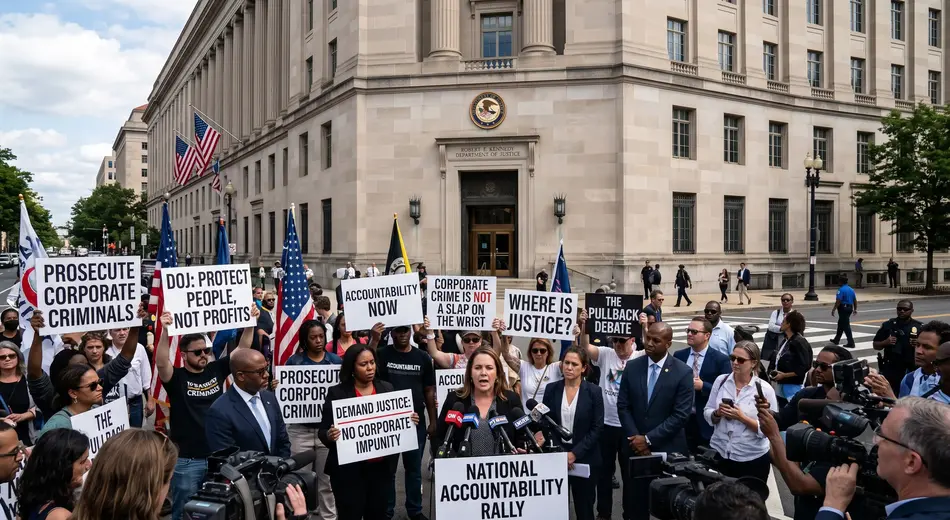
The U.S. Department of Justice is scaling back aspects of traditional corporate criminal enforcement, according to multiple reports centered on leadership decisions, resource realignment, and high-profile case closures. Critics call it a retreat from corporate accountability. Department officials and some practitioners describe it instead as a shift toward narrower priorities, civil remedies, and efficiency—with companies still facing risk in healthcare fraud, national security, and other designated areas.
The Abbott Labs Case as a Turning Point
The sharpest flashpoint is the DOJ’s decision to end a long-running criminal investigation of Abbott Laboratories over Cronobacter contamination tied to powdered infant formula produced at the company’s plant in Sturgis, Michigan.
- The 2021–22 outbreak was linked to infant illnesses and deaths; Abbott recalled Similac, Alimentum, and EleCare and briefly closed the plant, contributing to a nationwide formula shortage.
- Career prosecutors sought felony charges against the company and executives and had support from Criminal Division Assistant Attorney General A. Tysen Duva, according to people familiar with the matter cited by Bloomberg and CBS News.
- Senior DOJ leadership—then including the deputy attorney general’s office under Todd Blanche—overruled that approach and ordered the criminal probe closed.
- The department is pursuing accountability instead through a parallel False Claims Act civil track, with an agreement in principle that a senior official said includes a “significant” monetary penalty.
A senior DOJ official told CBS News a civil FCA resolution was “the best mechanism to achieve accountability, deterrence and protection of the public,” and said Abbott’s possible $1 billion Ohio facility plans played no role in dropping the criminal case.
Abbott maintains that no unopened, distributed Abbott infant formula tested positive for Cronobacter sakazakii, that plant strains did not match infant samples in key respects, and that FDA findings supported parts of that defense. In the civil case, DOJ lawyers have alleged the company misrepresented manufacturing conditions to USDA and state agencies—claims Abbott has contested in court filings.
AI Technology Infrastructure & Systems Governance Careers 2026
With **tier-1 global innovators anchoring on highly targeted, verified hiring platforms to optimize multi-cloud infrastructure and accelerate enterprise software asset yields**, the corporate demand for AI Systems Architects and Technology Procurement Directors is surging. Join the leaders of Multi-Jurisdictional Hardware Sourcing & Sovereign Tech Fleet Strategy, Asymmetric Multi-Cloud Database Integration & Algorithmic Capital Deployment Telemetry, and Data-Driven Infrastructure Asset Accounting & Regulated Tech Procurement FinOps Architecture.
Explore High-Stakes Roles →From One Closure to a Wider Food-and-Drug Pullback
Bloomberg Law reported that after the Abbott shutdown, Duva and top aides directed prosecutors to close other food and drug industry probes, and that supervisors raised the evidentiary bar for remaining health-and-safety corporate cases—partly to avoid another rejection by senior leadership.
That sequence has fueled the WSJ/Bloomberg framing of a wider corporate-crime retreat, especially in consumer-health enforcement historically associated with the Food, Drug, and Cosmetic Act.
Sen. Adam Schiff (D-Calif.) opened a congressional inquiry in a July 8, 2026 letter to Blanche, arguing that if felony-recommended cases involving infant risk are not priorities, “I have questions about what priorities the DOJ considers worthy of pursuing.” Schiff also asked whether Blanche personally reviewed the Abbott matter and raised questions about counsel firms’ relationships with the administration.
How DOJ Reorganized Corporate Enforcement
People familiar with the redesign told Bloomberg that a 2025 DOJ cost-cutting realignment:
- Dissolved a Civil Division consumer-focused office that helped launch the Abbott probe
- Merged those criminal prosecutors into the Criminal Division fraud section’s newer health and safety unit
- Restricted the prior flexibility to pursue both civil remedies and criminal indictments under one roof
Some veterans described skepticism inside leadership that prior consumer prosecutions were too aggressive or pursued on looser charging standards. Former consumer-protection attorneys have warned the changes may shrink the department’s appetite for corporate public-health cases.
Policy Backdrop: Fewer Traditional Cases, Narrower Priorities
The Abbott-centered pullback sits inside a larger policy reset under the current administration:
| Shift | What reporting describes |
|---|---|
| Focus, Fairness, Efficiency memo (May 2025) | Instructs white-collar prosecutors to shorten investigations, minimize collateral impact on companies, and ask whether misconduct warrants federal criminal charges at all |
| Monitorships | Independent compliance monitors disfavored; some existing monitorships ended early or reviewed for termination |
| Corporate Enforcement Policy | Heavier emphasis on voluntary self-disclosure, cooperation, remediation—and, in some cases, avoiding corporation-wide punishment for “a few bad apples” |
| FBI resources | Reuters reported agents ordered to prioritize immigration and scale back some white-collar work alongside Galeotti-era guidance |
| Priority lanes | Healthcare fraud, trade/customs fraud, cartels and transnational crime, sanctions, immigration-related employer cases, and certain national-security matters remain emphasized |
Separately, high-profile dispositions such as the drop of the criminal case against billionaire Gautam Adani—with DOJ officials citing foreign-conduct and “world police” concerns—have reinforced critics’ view that corporate criminal exposure is contracting at the top of the system even as civil or other tools remain.
The Counterargument: Changing, Not Vanishing
Not all lawyers and former prosecutors treat headline case closures as proof that white-collar enforcement is dead.
A July 2026 New York Law Journal analysis noted reports that DOJ dropped tens of thousands of criminal investigations early in the administration and that SEC enforcement hit a decade low in FY 2025—but argued corporate investigations are reallocated more than abandoned. As examples, it pointed to a June 2026 National Healthcare Fraud Takedown charging hundreds of defendants over alleged schemes totaling more than $6 billion, plus continued pressure on sanctions, export controls, cartel financing, immigration employment violations, and emerging prediction-market cases.
Criminal Division officials have publicly urged companies to self-disclose and “partner” with DOJ on compliance—while insisting the department has not quit white-collar crime, especially in healthcare.
The practical implication for companies is uneven: traditional food/drug consumer-health criminal exposure and broad monitorship risk may be lower under current leadership; exposure in DOJ’s priority lanes may still be high.
Target Elite Technical & Infrastructure Talent Natively
Whether you are expanding forward-deployed engineering teams to unlock multi-cloud AI architectures, sourcing specialized aerospace systems leads, or centralizing enterprise tech procurement desks, connect instantly with premium candidates while bypassing unoptimized ad spend.
Bottom Line
Reporting tied to The Wall Street Journal lead portrays a Justice Department that is deliberately pulling back from some forms of corporate criminal prosecution—illustrated by the Abbott baby-formula criminal-probe closure, follow-on food-and-drug case wind-downs, higher charging hurdles, and policy language that elevates efficiency and civil alternatives over sweeping corporate indictments. The administration presents that as focus and fairness. Lawmakers and former consumer-protection prosecutors see a retreat from cases that once defined corporate public-health accountability. Markets and compliance teams should treat the change as a reordering of risk, not a blank check—especially where healthcare fraud, trade, sanctions, and national-security theories still dominate.
Frequently Asked Questions
Q: Why is the Justice Department said to be pulling back on prosecuting corporate crime?
A: Reporting describes leadership choices to close or restrain certain corporate cases—most notably the Abbott infant-formula criminal probe—plus memo guidance to shorten white-collar investigations, prefer civil or administrative outcomes when criminal charges may not be warranted, reduce monitorships, and shift agents and prosecutors toward other priorities such as immigration, cartels, and targeted fraud.
Q: What happened in the Abbott Laboratories case?
A: After a long investigation tied to a 2021–22 Cronobacter infant-formula outbreak, prosecutors and Criminal Division head Tysen Duva sought felony charges; senior DOJ leadership closed the criminal case and moved toward a civil False Claims Act resolution with what officials call a significant penalty. Sen. Adam Schiff has demanded answers about that decision.
Q: Does that mean companies no longer face white-collar enforcement?
A: No. Coverage and legal analyses stress that DOJ still pursues healthcare fraud, sanctions/export cases, cartel-linked financial crime, immigration employment violations, and other priority areas. The change is better read as a narrowing and reallocation of corporate criminal risk—especially away from some traditional consumer-health and monitorship-heavy approaches—rather than a total halt.


