
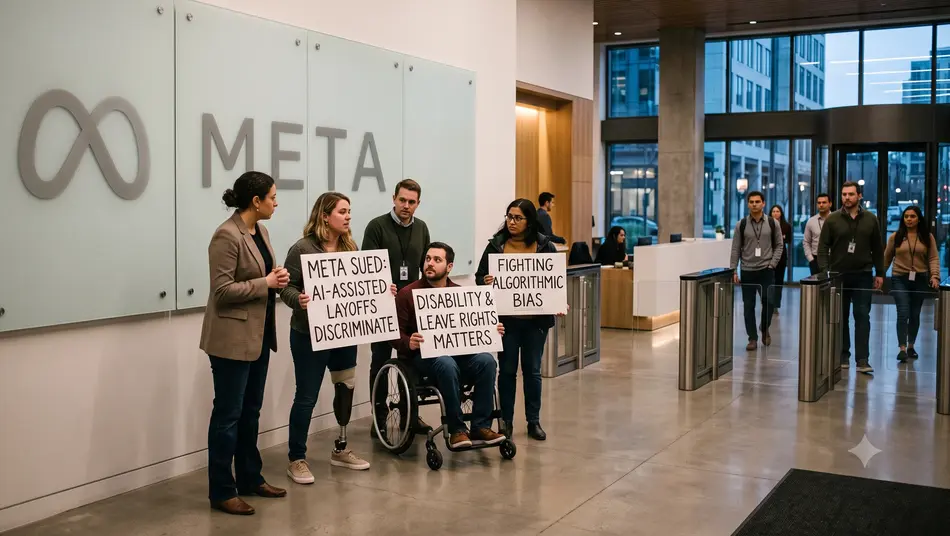
Current and former Meta employees sued the company, alleging it used artificial intelligence in its latest layoffs in a way that discriminated against workers on protected leave or with disabilities.
The complaint was filed Monday in the U.S. District Court for the Northern District of California. Attorneys for 26 unnamed workers say the plaintiffs were among the roughly 10% of Meta’s workforce cut in the company’s May layoff round. They want claims heard individually in arbitration and seek a preliminary injunction to preserve their employment status meanwhile.
What the Lawsuit Alleges
Plaintiffs say Meta violated protected-leave laws and discrimination statutes tied to pregnancies, disabilities, and related protections.
At the center of the case: a “constellation of internal artificial-intelligence systems” that allegedly failed to account for approved absences when ranking who to cut.
Those tools drew on inputs that workers out on leave—or with reduced output because of disability—could not rack up, lawyers wrote, including:
- Performance ratings
- Calibration scores
- Productivity and output metrics
- “AI-native” ratings
- AI-token consumption (used as a proxy for general AI usage)
The filing argues that by design, those scores cannot be accumulated by employees on protected medical or family leave—or whose output is limited by disability—so AI-assisted selection allegedly targeted them.
Courthouse News Service previously reported the suit.
AI Technology Infrastructure & Systems Governance Careers 2026
With **tier-1 global innovators anchoring on highly targeted, verified hiring platforms to optimize multi-cloud infrastructure and accelerate enterprise software asset yields**, the corporate demand for AI Systems Architects and Technology Procurement Directors is surging. Join the leaders of Multi-Jurisdictional Hardware Sourcing & Sovereign Tech Fleet Strategy, Asymmetric Multi-Cloud Database Integration & Algorithmic Capital Deployment Telemetry, and Data-Driven Infrastructure Asset Accounting & Regulated Tech Procurement FinOps Architecture.
Explore High-Stakes Roles →Meta’s Response
A Meta spokesperson told CNBC the “claims lack merit and are not based on facts.”
“Workforce management and organizational decisions were and are made by people, not AI,” the spokesperson said.
That framing matters: Meta is rejecting the idea that algorithms—not managers—made the cut lists, even as plaintiffs focus on AI systems feeding those decisions.
What Plaintiffs Want From the Court
| Request | Detail |
|---|---|
| Injunction | Preliminary order maintaining the “status quo” of their employment at Meta |
| Audit | Independent audit of the “algorithmically assisted selection process” |
| Merits | Resolution of discrimination/leave claims in arbitration |
The case sits at the intersection of two hot legal fronts: mass tech layoffs and the use of AI metrics—especially token usage and “AI-native” scores—in performance and retention.
Broader Context: AI at Work Under Scrutiny
The lawsuit lands nearly a month after a federal judge in California ruled against Workday in a separate case over AI in hiring. That court said Workday must face claims that AI-powered job screening violated state and federal discrimination laws.
Workday denied the allegations at the time, saying its recruiting software does not make hiring decisions and looks only at job qualifications—not protected traits—and that it tests products under a Responsible AI program.
Together, the Workday and Meta fights signal growing courtroom pressure on employers that use AI for who gets hired—or who gets laid off.
Target Elite Technical & Infrastructure Talent Natively
Whether you are expanding forward-deployed engineering teams to unlock multi-cloud AI architectures, sourcing specialized aerospace systems leads, or centralizing enterprise tech procurement desks, connect instantly with premium candidates while bypassing unoptimized ad spend.
Bottom Line
Twenty-six Meta workers from the May 10% cuts allege that AI-driven scores—performance, “AI-native” ratings, and token consumption—ignored protected leave and disability limits, unlawfully steering them into layoffs. Meta says people, not AI, made the decisions and that the claims lack merit. The case could force a rare look inside how Big Tech’s internal AI dashboards shape job cuts—and whether proxy metrics for AI use encode discrimination by design.
Frequently Asked Questions
Q: What are Meta employees alleging in the AI layoff lawsuit?
A: That Meta used internal AI systems and metrics—including performance scores, “AI-native” ratings, and token consumption—that workers on protected medical/family leave or with disabilities could not fairly accumulate, leading to discriminatory cuts in the May ~10% layoff.
Q: How has Meta responded?
A: Meta said the claims lack merit and are not based on facts, and that workforce decisions were and are made by people, not AI.
Q: What are the plaintiffs asking the court to do?
A: They seek a preliminary injunction keeping their employment status intact pending an independent audit of the algorithmically assisted selection process and arbitration of their claims.


