
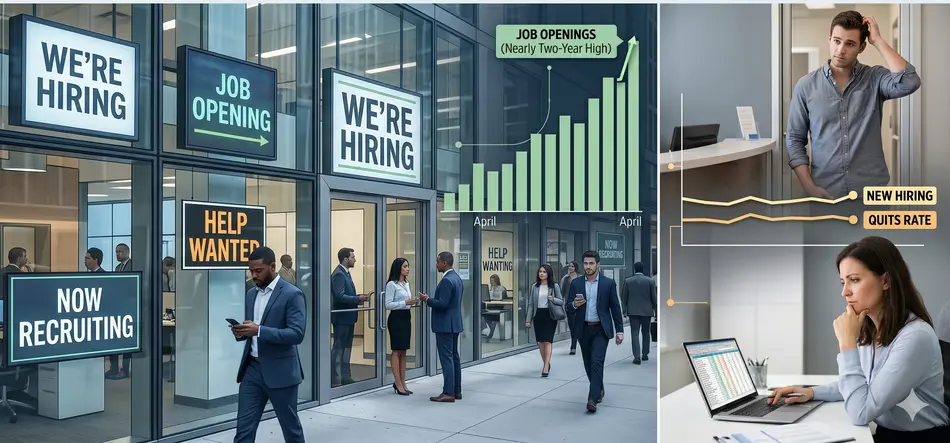
U.S. employers posted 7.62 million job openings at the end of April—the highest level in nearly two years—while new hires, layoffs, and voluntary quits all eased, signaling a labor market that is stabilizing but still stuck in a low-hire, low-fire pattern.
The jump in vacancies offers a potentially encouraging signal for white-collar workers and new graduates—but economists warn monthly figures can be volatile, revised, and vulnerable to geopolitical shocks that could unwind early-2026 gains.
What April JOLTS Showed
The Job Openings and Labor Turnover Survey painted a mixed picture:
- Job openings: Rose to an estimated 7.62 million from 6.89 million in March, reversing a two-month decline
- Hiring: Fell after a March spike
- Layoffs: Also retreated after March’s jump
- Quits: Voluntary departures hit their lowest level in nearly six years, suggesting workers are clinging to existing jobs amid uncertainty
In short: businesses are posting more roles, but not necessarily converting those wish lists into payroll additions at the same pace.
Human Capital Infrastructure & Workforce Strategy Careers 2026
With **U.S. job openings unexpectedly rebounding to 7.6M while gross hires fall and voluntary quits stagnate at a low 1.9%**, the enterprise market demand for Human Capital Directors and Talent Sourcing Architects is surging. Join the leaders of Multi-Jurisdictional Workforce Architecture & Headcount Capacity Governance, Asymmetric Talent Mobility Optimization & Employee Retention Modeling, and Data-Driven Compensation Engineering & Enterprise Recruitment Sourcing.
Explore High-Stakes Roles →More Openings Than Job Seekers—For the First Time in a Year
For the first time since June 2024, there are more job openings than unemployed job seekers—a milestone Heather Long, chief economist at Navy Federal Credit Union, told CNN could give seekers hope.
If April’s spike is not revised away as a one-month blip, it could mean the labor market is not only stabilizing but possibly expanding—countering months of worry that AI and sector-specific contractions would keep white-collar hiring frozen.
Bill Adams, chief U.S. economist at Fifth Third Commercial Bank, called the openings jump encouraging for students finishing school this year but cautioned it should not outweigh other indicators: collective data still point to modest employment growth, faster than the growth in job seekers but far from a hiring boom.
White-Collar Openings Led the Surge
More than 90% of April’s increase in job openings came from professional and business services, BLS data showed—sectors that have faced contraction fears and AI-related anxiety.
Noah Yosif, chief economist at the American Staffing Association, told CNN that if the trend holds, it pushes back on the narrative that artificial intelligence will be a mass job-killer. Employers, he said, are finding ways to keep humans in the loop even as responsibilities shift as technology spreads.
That could matter for college graduates and knowledge workers who have struggled in a market CNN and others have described as strong on unemployment rates but weak on actual landing offers—see the related tension in CNN’s prior reporting on why hiring still feels hard despite headline strength.
Why Postings Outpace Hires
Yosif attributed part of the openings-versus-hiring gap to rising labor costs and broader economic uncertainty. Hiring the wrong worker is expensive; employers are taking longer to match roles to candidates they trust.
That dynamic fits the “low churn” story: fewer quits, fewer layoffs, fewer hires—workers and firms both acting cautiously.
Labor market turnover has slowed over the past two years amid aging and retirements, post-pandemic hiring normalization, new technology, policy and immigration shifts, and geopolitical risk.
War, Oil, and What Could Reverse the Gains
Economists have warned that the U.S.-Israeli conflict with Iran—and related oil and supply shocks—could suppress U.S. hiring.
Yosif noted the Strategic Petroleum Reserve release has helped blunt oil-price effects for now, and both sides have signaled progress toward a deal. But he said that posture may not last: oil supplies could tighten, investors may demand clarity on the Strait of Hormuz, and early-2026 job-market gains could reverse.
Monthly JOLTS data are also subject to revision when May figures arrive, and survey response rates have been a persistent concern for labor statisticians—another reason to treat one strong month as hopeful, not definitive.
Struggling to Fill Roles in a Cautious Hiring Climate?
With job openings at a two-year high but candidate movement frozen, finding active, high-intent talent is critical. Connect with qualified professionals instantly without the “click tax.”
Bottom Line
April’s JOLTS report is a bright spot on the demand side: nearly 7.62 million openings, a professional-services-led surge, and—for now—more vacancies than unemployed workers. But hiring did not keep pace, quits hit multi-year lows, and geopolitical risk still looms. Job seekers—especially in white-collar fields—may finally see more doors listed; whether those doors open quickly enough is the next test.
Frequently Asked Questions
Q: How many U.S. job openings were there in April 2026?
A: BLS JOLTS data cited by CNN estimated 7.62 million openings at the end of April, up from 6.89 million in March—the highest level in nearly two years.
Q: Did hiring increase with job openings?
A: No. CNN reported that hires and layoffs both fell in April after March spikes, while voluntary quits dropped to a nearly six-year low—consistent with a cautious, low-churn labor market.
Q: Which industry drove the rise in openings?
A: More than 90% of the April increase came from professional and business services, according to BLS data cited by CNN.


